
*** This post is an adapted version of one part of my #CrossChannelRail Project Final Report ***
Let’s get one thing out of the way first: the problems here are nothing to do with the Avelia Horizon trains being double deck. The loading gauge in the Channel Tunnel and HS1 is adequately large for double deck trains. And LeShuttle trains carrying cars through the Channel Tunnel are also double deck with staircases. However LeShuttle trains are more than 700m long and that means they are OK. As will be made clear, it is door placement and train length that concerns us here, not whether a train is single or double deck.
Right then, with that cleared up, we can get to the heart of the matter.
The two existing train types that operate long distance high speed services through the Channel Tunnel (TMST and Siemens Velaro 16 carriage version) are both single units, each train type just under 400m in length. Yet none of the trains that Eurostar or any of its rivals are considering purchasing have this format. Instead trains around 200m length would be purchased, with the opportunity to couple two of them together to make a 400m long formation.
The notion has long persisted that trains must be long single units as cross passages to the service tunnel in the Channel Tunnel are 375m apart, but this is not the case – a 2x 200m formation is permitted in principle. This was the system Deutsche Bahn wanted to use for its planned London trains in the early 2010s, before aborting the plans.
Ordering 200m trains brings numerous advantages. First, all the main manufacturers are offering their high speed trains as 200m units as this fits with operational models on high speed networks elsewhere in Europe. Second, in the specific case of the Channel Tunnel operations, it allows some stations to be served that could not accommodate a 400m train (my #CrossChannelRail report explores these options in different stations). And third, it allows a train to be split somewhere en route, to allow one train departing from London to serve multiple destinations.
However the 2x 200m format can pose some practical problems with regard to evacuation rules in the Channel Tunnel. Rules for this make a distinction between a controlled and an uncontrolled stop of a train in an emergency situation.
An uncontrolled stop happens in the case of an immediate danger – the train that passengers are on is on fire for example. Priority here is to get everyone out as fast as possible. However how these situations are handled has been beset with confusion in the public debate for years. The idea has erroneously persisted that a minimum train length of 375m is required for trains to be allowed to operate, so as to ensure there would always be at least one passenger door close to a cross passage to the service tunnel. But LeShuttle truck shuttles (where drivers are sat in a single carriage), and proposed North of London TMST trains and Nightstar night trains have never had 375m length of the passenger compartment, nor a way for passengers to get through the train in the case of a truck shuttle. In these cases the walkway along the side of the running tunnel would have to be used for evacuation in the case of an uncontrolled stop, and so would be the case for a high speed passenger train.
But train door placement does matter in the case of an evacuation with a controlled stop, albeit in a slightly different way. And that is what is a concern here.
A controlled stop is where the train with the passengers on board is not in an immediately critical situation, and the driver can bring the train to a standstill at a designated place in the tunnel as required. However this includes the case of a power cut, or smoke ingress in the running tunnel from a fire on board another train.
With current rolling stock used through the Channel Tunnel the procedure in the case of a controlled stop means aligning the front passenger door with a cross-passage between the running tunnel and the service tunnel, to allow evacuation through that door. Evacuation can be through another door or doors onto the walkway in the running tunnel as well if the safety situation allows, even if those doors are not near a cross passage, but the principle is clear: a one door evacuation is permissible and in some cases necessary or desirable.
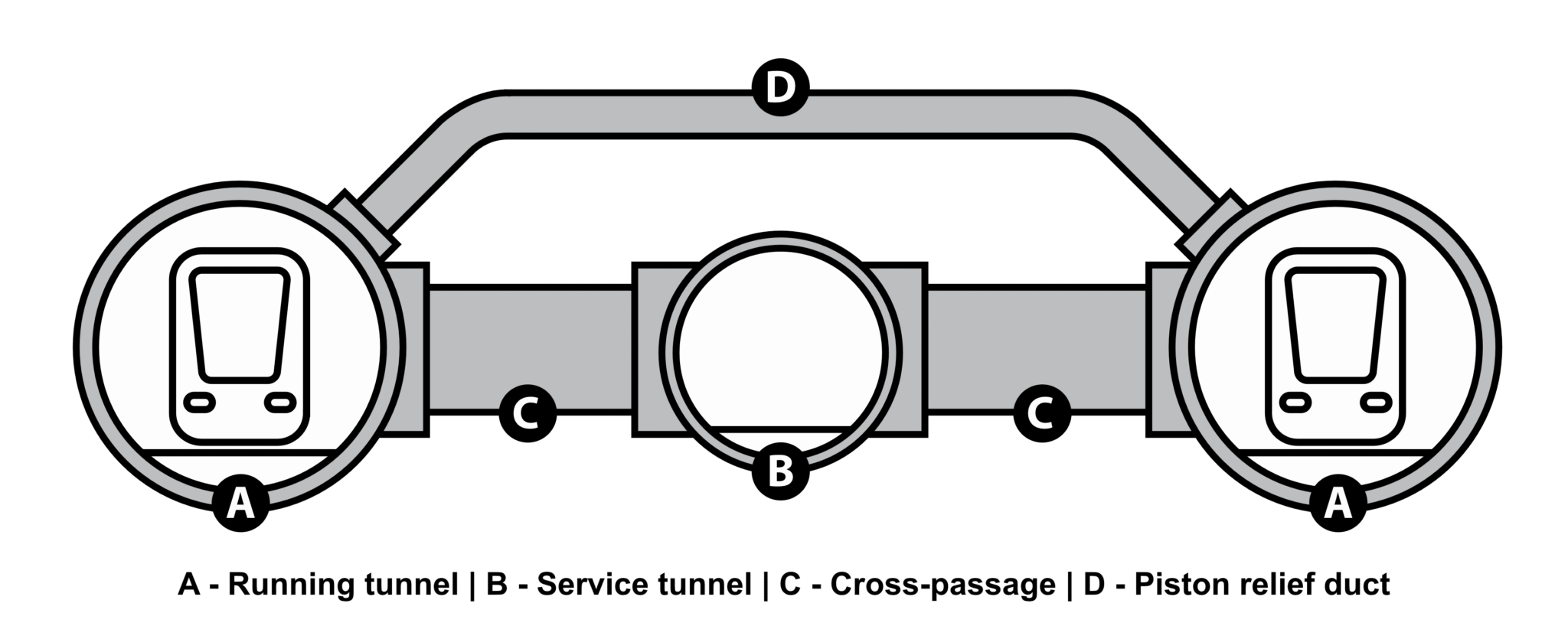
Once the driver has stopped the train aligned with the cross-passage (there are markers in the running tunnel for this purpose), all passengers can be evacuated there. Persons with reduced mobility and wheelchair users can also be evacuated through this one door, and special narrow evacuation wheelchairs are carried on board and can be pushed along the aisle by on-board staff (train managers or catering staff). Wheelchair users’ own wheelchairs are likely too wide to pass along the middle aisle of the train, so are left behind.
Existing TMST and 16 carriage Velaro trains have two important common features in this regard: they are single deck trains, with both a level floor inside and continuous aisle throughout the train, allowing passengers and the evacuation wheelchairs to pass along the entire train without restriction.
It is obvious that operating a single 200m unit would comply with these rules (and for any of the 200m train types), as evacuation could be through just one door in these cases. For the Avelia Horizon, without a continuous corridor at the lower level, the evacuation door would have to be the door where wheelchair users are located.
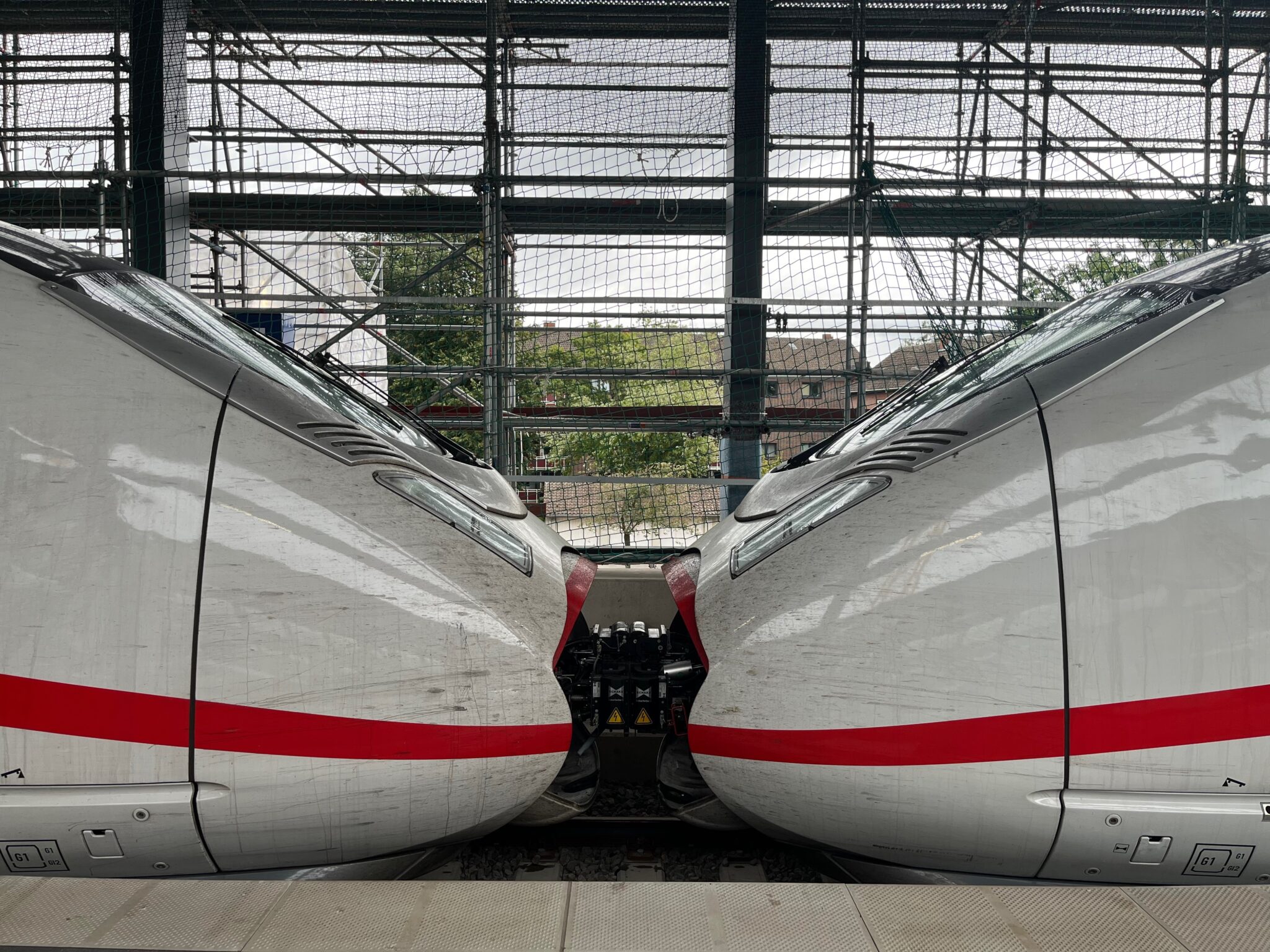
However coupling 2x 200m units together calls this system into question.
In the case of a two unit train formation – were a controlled stop leading to an evacuation is needed in the tunnel – passengers will have to be evacuated from front and back units separately, as there is no through passage between the two units. Evacuation from one door only is impossible.
Evacuation cross-passages in the Channel Tunnel are on average at 375m intervals. The most obvious solution would be to align a door of the front unit with one cross-passage (+/- 5m) and align a door of the rear unit with the following cross-passage (+/- 5m). This is all explained in “Technical Investigation Report concerning the Fire on Eurotunnel Freight Shuttle 7412 on 11 September 2008” and it de facto would mean 365m to 385m between train doors is necessary (likely the front door of the front unit and the back door of the back unit).
Train types with distributed traction – Siemens Velaro 8 carriage or Velaro Novo 7 carriage, Alstom Avelia Stream, and Hitachi ETR1000 – have passenger cabins and doors throughout almost the whole length of the unit, including just behind the driver’s cab, although in the Hitachi case it is only a service door, like this:
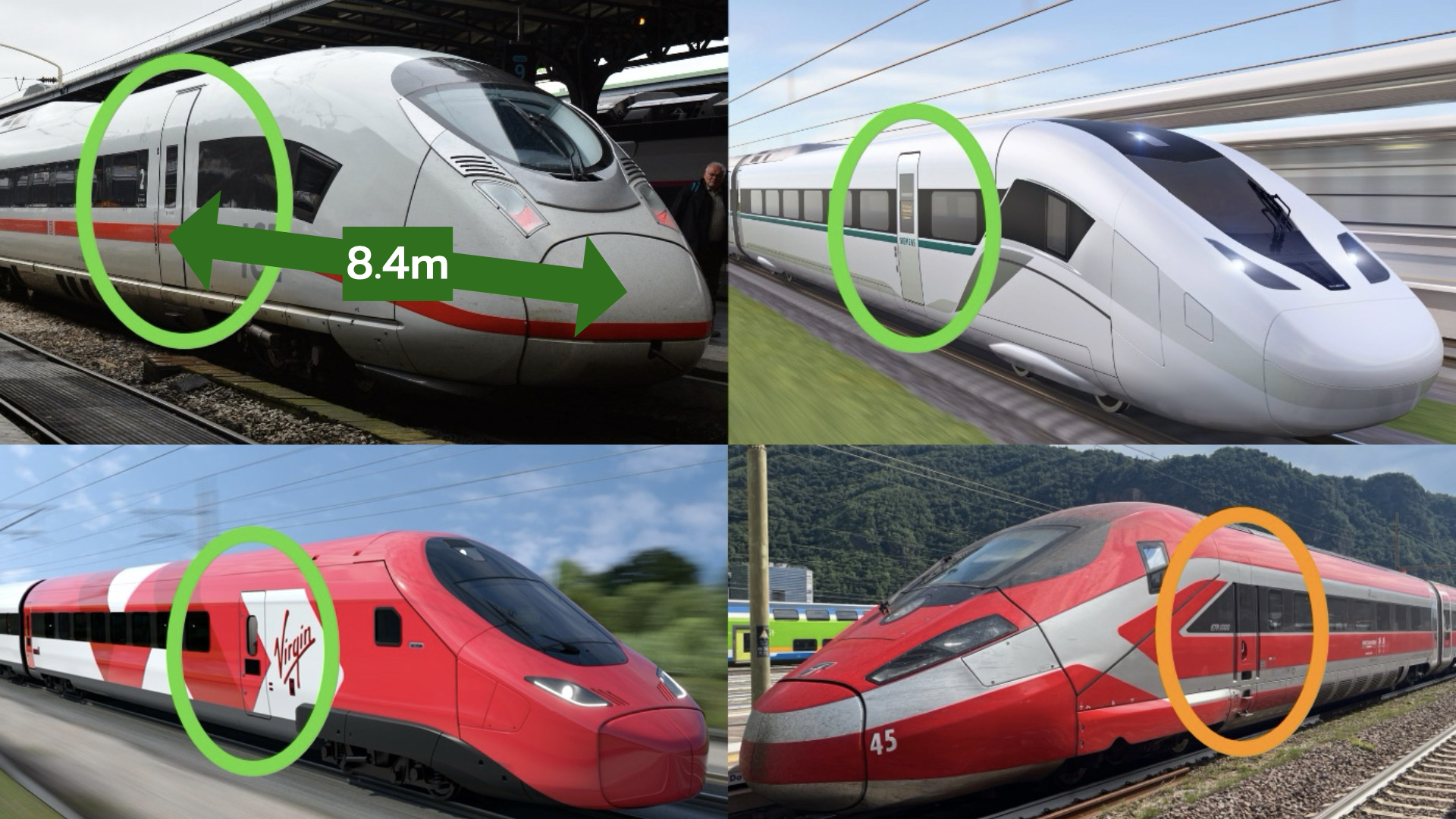
For example in the case of the 8 carriage Velaro in service for Deutsche Bahn as ICE3neo, the distance from the front of the nose to the middle of the first passenger door is 8.4m, meaning the distance between the front door of the front unit to the back door of the back unit is 384.6m – just within the safe limit.
However the Alstom Avelia Horizon and Talgo Avril have power cars at the front and rear of each 200m unit, and in the case of Avelia Horizon the passenger door is at the rear of the first carriage. I focus here on the Avelia Horizon as that has been ordered by Eurostar, while operations of the Talgo Avril are only a theoretical possibility for now.
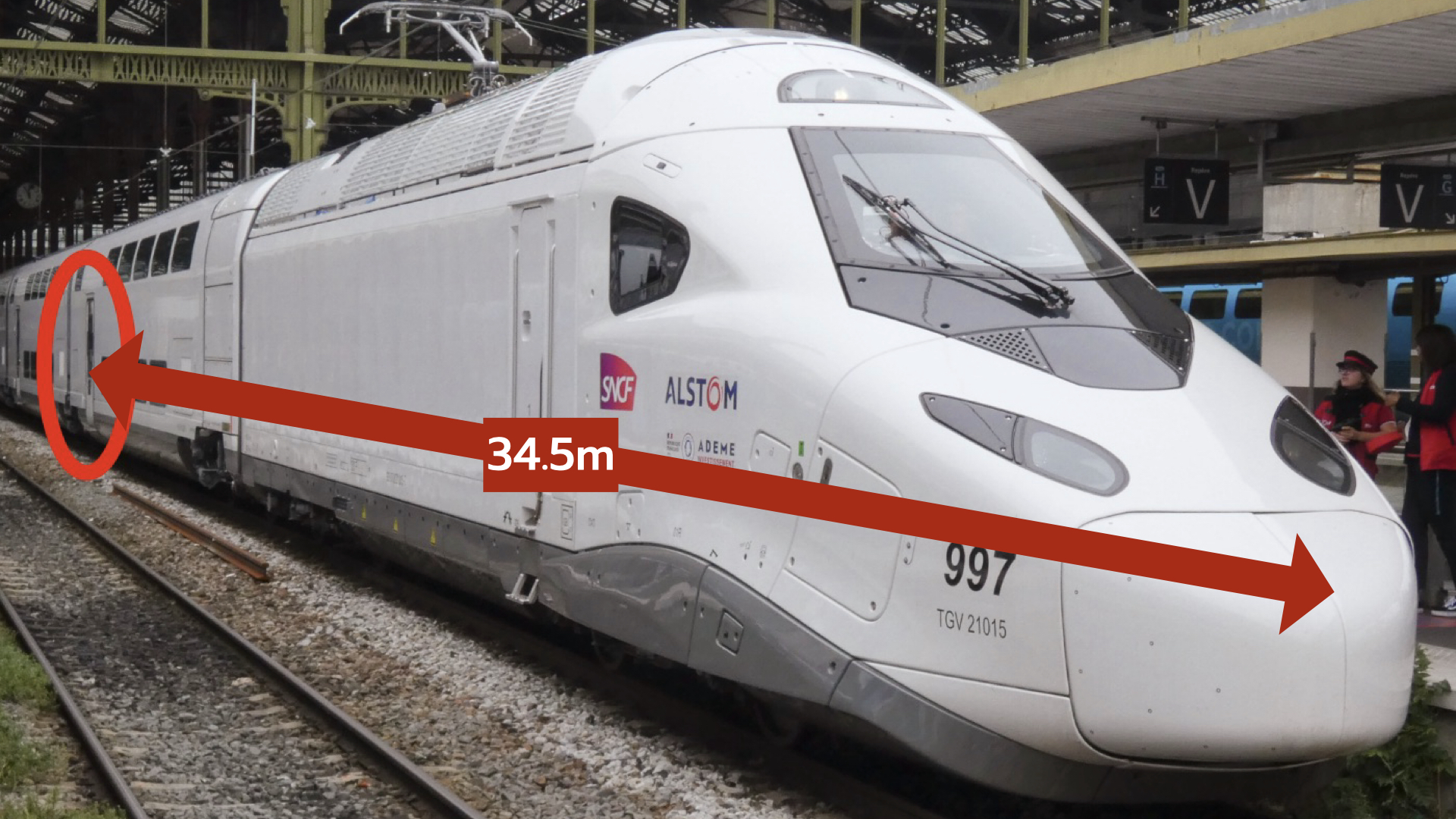
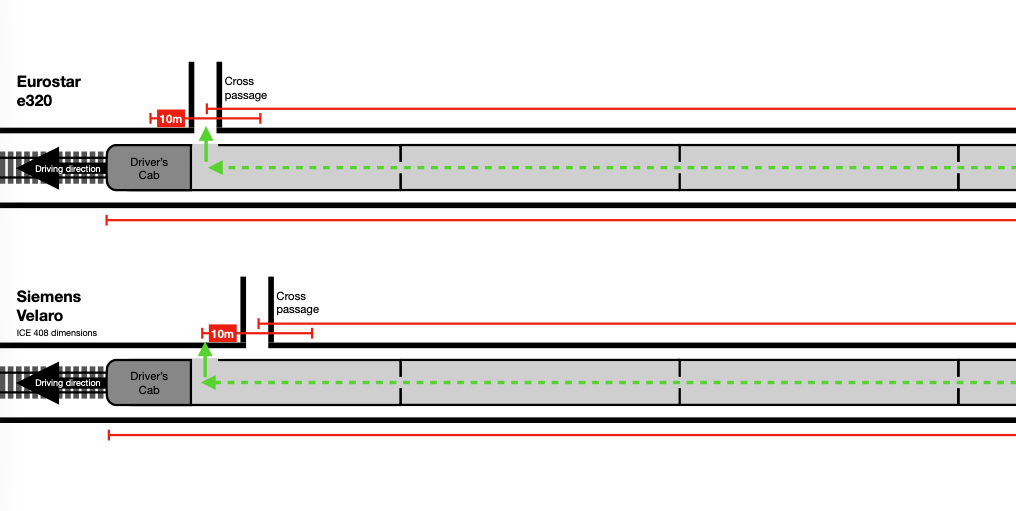
The distance from the front of the nose of an Avelia Horizon to the middle of the first door a passenger could access is more than 34m. That means the distance from the first passenger door on the front unit to the back passenger back door on the back unit is just 333m, more than 30m short of the 365m that would be required.
Even if the format of the first carriage could be reversed to put the door at the front of the carriage, the distance from nose to middle of the door would still be 24m, so front door of front unit to back door of back unit would still be only 353m, still missing by 12m. Scale diagrams of both of these cases are in this PDF.
While the front unit could be evacuated directly into a cross passage, the back unit could not. Passengers (including wheelchair users) would need to use the walkway along the running tunnel that currently can be avoided in controlled stop situations. Were the running tunnel filled with smoke – as was the case in the 2008 fire – this situation is not ideal.
Theoretically there would be other ways to solve this problem, but they each have their own downsides.
Running only a single 200m Avelia Horizon train, rather than 2 coupled together, would of course be permissible. But as each 200m unit is to have 540 seats, versus 758 in a TMST and 902 in a 16 carriage Velaro, that might be OK for off peak services but it is no good for peak hours services, not least as the 8 remaining TMST trains are end of life and need to be replaced.
Lengthening each unit from 200m to c. 218m – making a Avelia Horizon 10 rather than 9 carriages for example – would solve the door placement problem, but would mean two trains coupled would exceed 400m and hence would not fit the platforms in Paris Gare du Nord, where platforms are only just over 400m total length and hard to extend. So this can be ruled out.
Splitting the train in two in the case of a controlled stop could be a solution. The train would be stopped, split, and one half would be moved after the stop. However this would have to function even in the case of a power cut, so would need on board battery packs. But batteries present their own fire risk, and batteries had to be specially designed for existing Channel Tunnel trains even for matters as mundane and low power as emergency lighting. It is unknown if the Avelia Horizon backup battery to move the train would be permitted in the Channel Tunnel – more about that system here.
Alternatively the Channel Tunnel Safety Authority could decide to amend the procedures to suit new train types. Or the manufacturer or operator of a train compliant with the EU Technical Standards of Interoperability could argue that EU law is supreme over national law, and hence the train must be approved. But that would take years to prove, whatever the outcome, and would present the risk of delays approving the train. That would put the 2031 entry into service of these Avelia Horizon trains in some question.
Given the very real experience of fires in the Channel Tunnel, especially the 2008 case that resulted in the formulation of the evacuation rules as they are currently, there is a genuine issue here that must be adequately addressed before 2 coupled Avelia Horizon 200m trains can run safely.
And all of this could perhaps explain why Eurostar has ordered only 30 and not 50 Avelia Horizon trains. The company could use the Avelia Horizon units to replace its PBA and PBKA fleet on ex-Thalys routes, and eventually order something else for the Channel Tunnel.
Images used in this post
Velaro Novo high-speed train. Source: © Siemens AG, press image. ID: f5cc3704-b5ff-439b-a9a1-630c85f9944f
Computer rendering of Virgin Trains’ future Avelia Stream. © VTE HOLDINGS.
Eurotunnel schema (empty service)
Original by Arz, tiny modification by Commander Keane
February 19, 2018
Public domain
DSC_0802
Cheng-en Cheng
September 26, 2019
CC BY-SA 2.0
Le TGV M à la gare de Lyon lors de sa présentation le 31 juillet 2023.
Rémi Simonnin
July 31, 2023
CC BY-SA 4.0
Other photos and diagrams are mine.
[Update 23.11.2025, 16:00]
I have repeatedly been asked whether these problems are due to the Avelia Horizon trains being double deck, and the answer to that is no. This is all about door placement, not that that the trains are double deck. I have added a paragraph right at the start of the post to make this clear.
Now if we want to be really pedantic the double deck design does indirectly have an impact. No European manufacturer has yet built a high speed, double deck, distributed traction design – as that would likely exceed the permissible axle load. So we have either single deck distributed traction designs, or double deck designs with power cars. And it is the power car that means the first door is too far from the front of the train. But a single deck design with power cars – like a Talgo Avril for example – would fail for the same reason – door placement.



.svg)
.jpg)
Great article, good to see coverage on the details of rolling stock and implications for operations and emergency situations. Is it possible to include the Avelia Stream in the evacuation diagram?
Overall, it’s been fascinating to follow the current happenings in cross channel rail.
Cheers
Thanks for the comment, but no, I can’t do that precisely as I have no way of knowing the exact distance between the front of the nose of a Stream and the middle of the first door. Same with Velaro Novo. All I can say is both are *roughly* the same as a Velaro. As and when we have precise measures I will be able to make a diagram.
Replacing the PBA/PBKA fleet is more urgent than the Channel Tunnel fleet. So, Eurostar (at least) has time for a suitable train.
Another (maybe minor) issue is a functioning internal lift for evacuating wheelchair users, unless they are strictly limited to the first car in the consist, depending on the direction of operation.
Yes, I agree that replacing PBA/PBKA would make most sense. BUT Eurostar has said precisely the opposite – listen to Gareth Williams from Eurostar on Green Signals for example.
Regarding wheelchair users: yes, this presents hurdles as well. You would have to have wheelchairs in the front carriage of the front unit, and the back carriage of the back unit. And given a train could be running backwards, that would mean you would have to have two wheelchair areas per unit – in both the first and the last carriage. The TGV-M for SNCF has just one wheelchair area.
The lift arrangement to get wheelchairs out in the case of a Channel Tunnel evacuation is probably OK, but it gets messy in everyday use – because platforms in Belgium and Netherlands, and along HS1, are 76cm, and the wheelchair lift in a TGV-M is built for 55cm platforms. How that will be adapted for Eurostar’s purposes is unknown currently.
The wheelchair lift is inside the train. At stations without level boarding, wheelchair users have to request assistance for boarding.
The lift is designed for independent/autonomous boarding and is quite slow. In case of evacuation and all five wheelchair spaces in use, I hope there’s an emergency ramp to be deployed by the staff between the lift and the lower deck.
https://www.youtube.com/watch?v=xY_zgW5NL7Q
That’s the procedure for 55cm platforms in France.
You need *additionally* an extra manually deployed ramp up to 76cm platforms in Belgium, Netherlands and along HS1.
Inside the Channel Tunnel you can probably evacuate to the walkway from the wheelchair lift (55cm) if that door is the one aligned with the cross passage.
What if we took the subject from another angle?
The Channel Tunnel was the first of this length in Europe. Since then, other twin-tube structures of more than 20 kilometers have seen the light of day in Switzerland or Spain. And it’s not over, with the Koralm, the Brenner, the Mont-cenis, the Semmering and others. All these tunnels are likely to be traversed by passenger trains.
I do not know precisely the security and evacuation measures in force. It would be logical for them to be harmonized at the continental level, if only to avoid having to develop a specific rolling stock to each situation.
The Gotthard Base Tunnel has the cross passages every 325m rather than 375m in Chunnel.
Koralm is going to have them every 500m with a platform for detraining into the same train tunnel also every 500m at the midpoint between them.
Brenner is going to have them every 333m
Mont Cenis is going to have them every 333m
Semmering is going to have them irregularly spaced on average every 500m
So no standardisation.
No other tunnel has such strict rules. In Switzerland they are used by conventional passenger trains with sometimes short sets of 3 or 4 cars separated from the rest…
And do they really want to evacuate 900 passengers through a single door ? It would take ages, and even it it theoretically protects passengers from smoke, I’m not sure it would run smoothly in real life…
They can evacuate 900 passengers through a single door indeed. If *necessary*. If it is not necessary (no smoke in the tunnel) then they can use more doors.
I am not sure how this helps us! You need to make sure the Avelia Horizon is compatible with the Channel Tunnel.
Doesn’t accessibility legislation require that wheelchair users are able to be carried in every class of travel?
Hard to see how that’s compatible with carrying them only in one specific area on each unit.
That suggests the double deck configuration might pose a problem after all.
With the notable exception of the SBB Giruno, all examples have only one accessible area (including the most recent ones like TGV M, Frecciarossa 1000 or BR408).
Avelia Horizon as built for SNCF (they call it TGV-M) has only one wheelchair area, but that is in a first class carriage. How they propose to price those places I have no idea.
But to make sure an Avelia Horizon can be evacuated in the Channel Tunnel you are going to need to make sure the wheelchair places are next to the cross passage, so these will have to be in the first carriage of the train (I presume).
I suppose you could make these places 1st or 2nd class according to the ticket class bought?
(I am not disputing your point here – simply this train design makes some other things damned complex)
A fascinating and well informed article. Thank you !